Beneath the cobbled alleyways and blond-stone façades of Saint-Émilion lies a world that most visitors never suspect: a network of underground galleries that is estimated to stretch for nearly 200 kilometres. An invisible heritage, as vast as it is little known, yet which is the very origin of the town built upon it.
A town that carved itself
Paradoxically, the story begins with the construction of the town above ground. As early as the early Middle Ages, Saint-Émilion's builders did not source their stone from afar: they extracted it directly from the subsoil, carving out the stone as they built. This astated limestone, soft to extract yet hardening on contact with the air, was ideal for erecting houses, ramparts and monuments.
Every house built on the surface corresponds, or nearly so, to a quarry excavated below. The town we visit today literally rests upon the void it created for itself in order to be built. This extraction principle, continued for centuries from the 9th to the 19th century, ultimately created a labyrinth of galleries, quarries and cellars running beneath the entirety of the Saint-Émilion jurisdiction.
The monolithic church: a masterpiece carved, not built
The most spectacular testimony to this stonework remains the monolithic church of Saint-Émilion, considered one of the largest underground churches in Europe entirely hewn from the rock.
Unlike a traditional building where stones are piled on top of each other, here it is the reverse: between the 9th and 12th centuries, monks and stonemasons carved the limestone rock from top to bottom and from the inside out, removing material rather than adding it, to sculpt a nave, pillars and a vault directly from the mass of the hill itself. The volume is impressive: around 38 metres long, more than 20 metres wide, and a vault height of 12 metres, worthy of a cathedral yet situated entirely underground.
This church is inextricably linked to the founding legend of the place: that of the hermit Émilion, a Breton monk who retreated in the 8th century to a cave in this very hill, around which the religious community and later the town gradually structured themselves.
From stone quarry to the ideal barrel cellar
For a long time, these quarries emptied of their stone remained forgotten spaces, sometimes filled in, sometimes hazardous. Ground subsidences, locally known as fontis, even punctuated the town's history up until the 20th century, when certain poorly identified cavities gave way under the weight of construction.
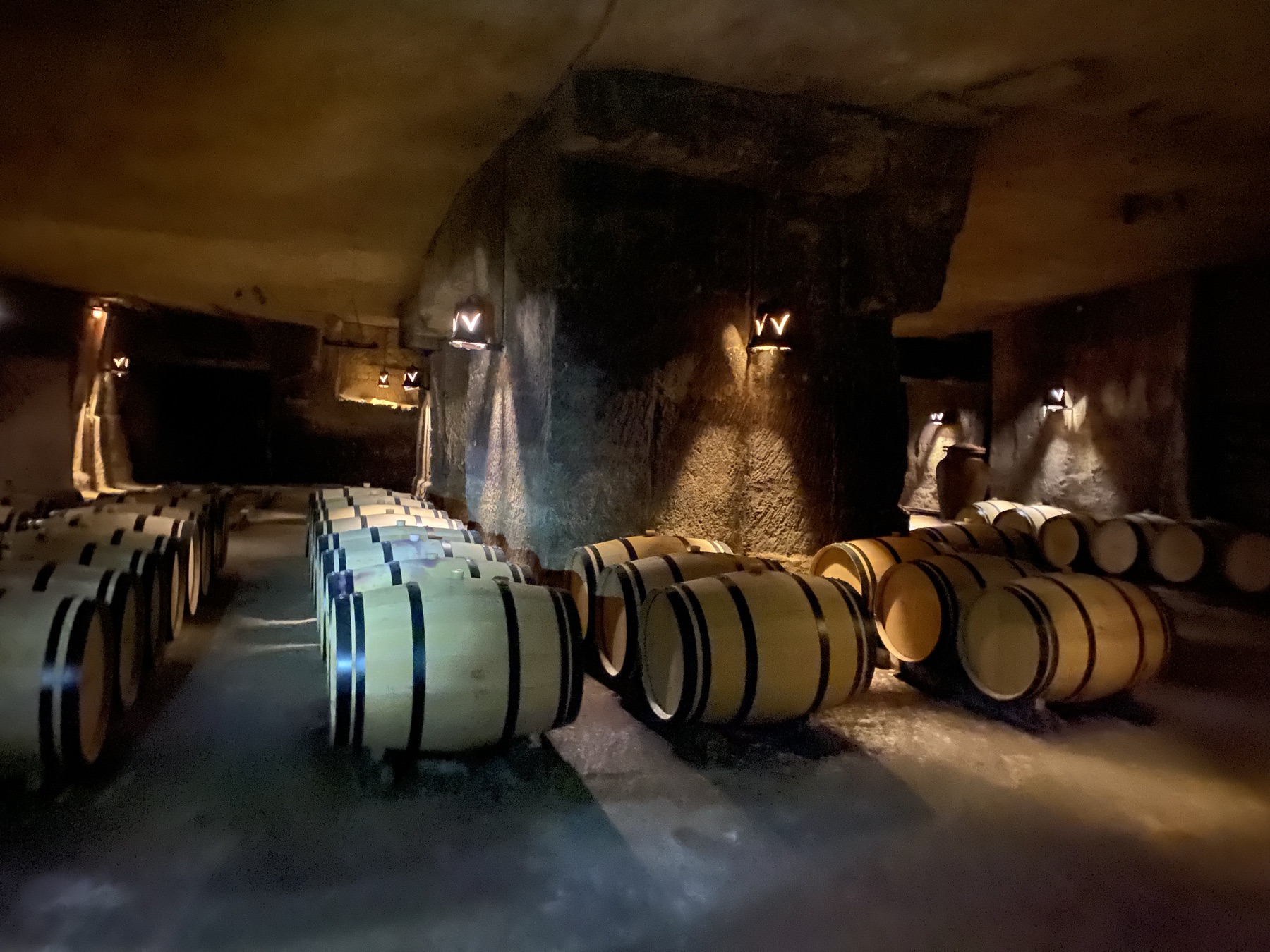
Yet what was once perceived as a constraint has, over time, become a premier wine-growing asset. Indeed, these galleries offer conditions that are virtually ideal for maturing wine:
- a stable temperature, generally between 11 and 13°C all year round, free from the brutal variations of the surface;
- a high and constant humidity level, around 90%, which limits the evaporation of wine from the barrels (the famous angel's share);
- total darkness, conducive to slow, steady ageing, sheltered from any stray light;
- silence and stillness that promote the natural clarification of the wines.
Numerous châteaux and wine merchants in Saint-Émilion have thus transformed former quarries into underground ageing cellars, where barrels now rest in the very same galleries that provided the stone for their own walls. An almost perfect loop between the history of architecture and that of wine.
A subsoil that remains largely mysterious
Despite mapping campaigns carried out over several decades, part of this network remains imprecisely known. Some galleries were deliberately filled in for safety reasons, others were forgotten, blocked by collapses, or simply never linked to official surveys. Municipal services and urban caving associations continue, to this day, to explore and consolidate certain sectors.
This unknown element adds to the fascination exerted by Saint-Émilion: the town wandered across on the surface is, in reality, only the visible half of a much vastest ensemble, patiently carved for over a millennium.
A heritage with a dual reading
What makes Saint-Émilion's subsoil so unique is that it tells not one story, but two intertwining ones: that of an exceptional architectural and religious heritage, of which the monolithic church is the pinnacle, and that of a living wine heritage, where hundreds of thousands of bottles age each year in centuries-old galleries.
Few vineyards in the world can claim such a physical link between the place where a town was built and the place where wine is matured today. In Saint-Émilion, terroir is not limited to the vine on the surface: it extends, literally, beneath the visitor's feet.